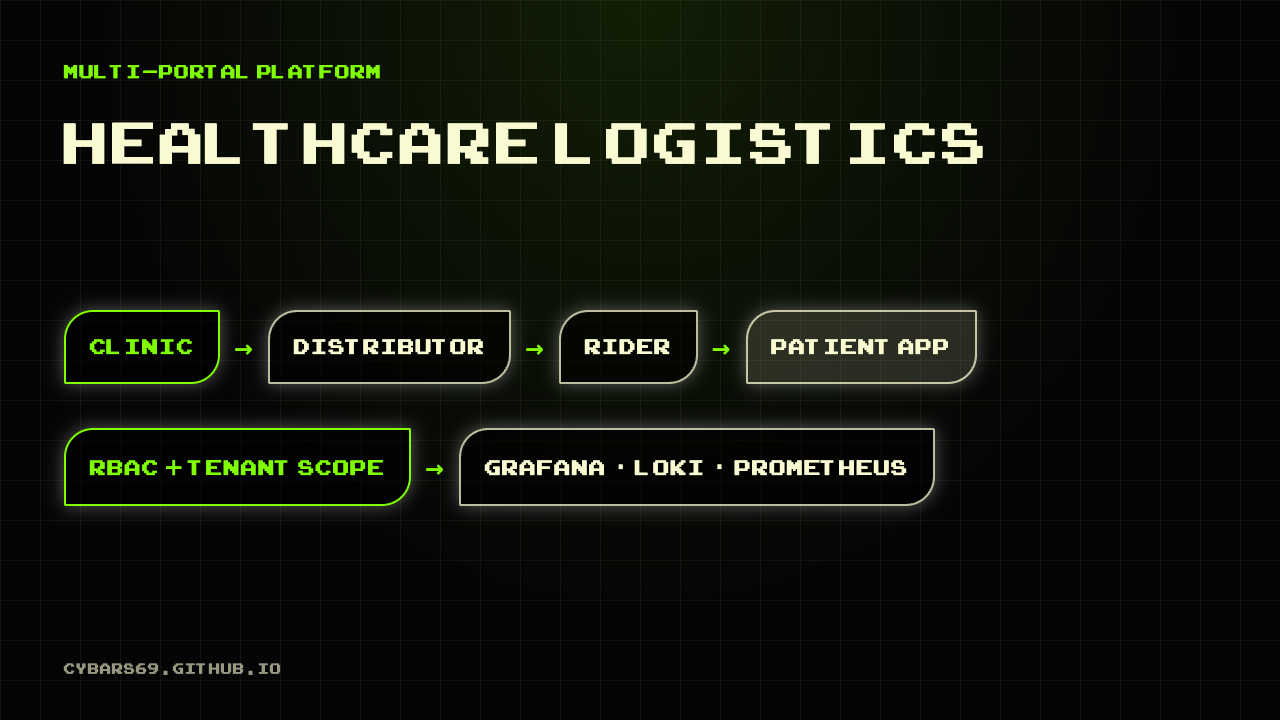
Healthcare supply platform
A platform that moves medicine and appointments through a healthcare supply chain: clinics order, distributors fulfil, riders deliver, and a patient app lets people order medicines and book teleconsultations or in-person visits.
One identity, many portals
Authentication is shared across every surface. Access tokens are JWTs, refresh tokens live in the database, and every route is checked against portal access, role-based permissions and tenant scope. One person can belong to several clinics and several distributors, and use several portals, without duplicate accounts.
The patient app
A React Native app for signed-in patients to order medicines and book appointments. The operator side is deliberately small: three focused admin consoles for e-commerce operations, prescription review (pharmacists verify or escalate, interns contact patients and adjust or reject orders from a mobile-first workspace), and appointment disputes. Anything lab-shaped stays visible but marked “coming soon”, and upsells that would blur the scope were explicitly excluded.
Observability, kept separate
Logs and metrics run as their own stack: Grafana, Loki, Promtail, Prometheus, cAdvisor and node exporter, in a separate compose file from the application, with a provisioned host dashboard. When the app is on fire, the tooling to look at the fire shouldn’t be in the same building.
Documents with an authority order
The project accumulated dated context notes over months. A README states the order of authority when they conflict, and old notes mark superseded decisions as redacted instead of silently contradicting the new ones.
Stack
Python, FastAPI, SQL migrations, React Native, Docker, Nginx, Grafana, Loki, Prometheus.