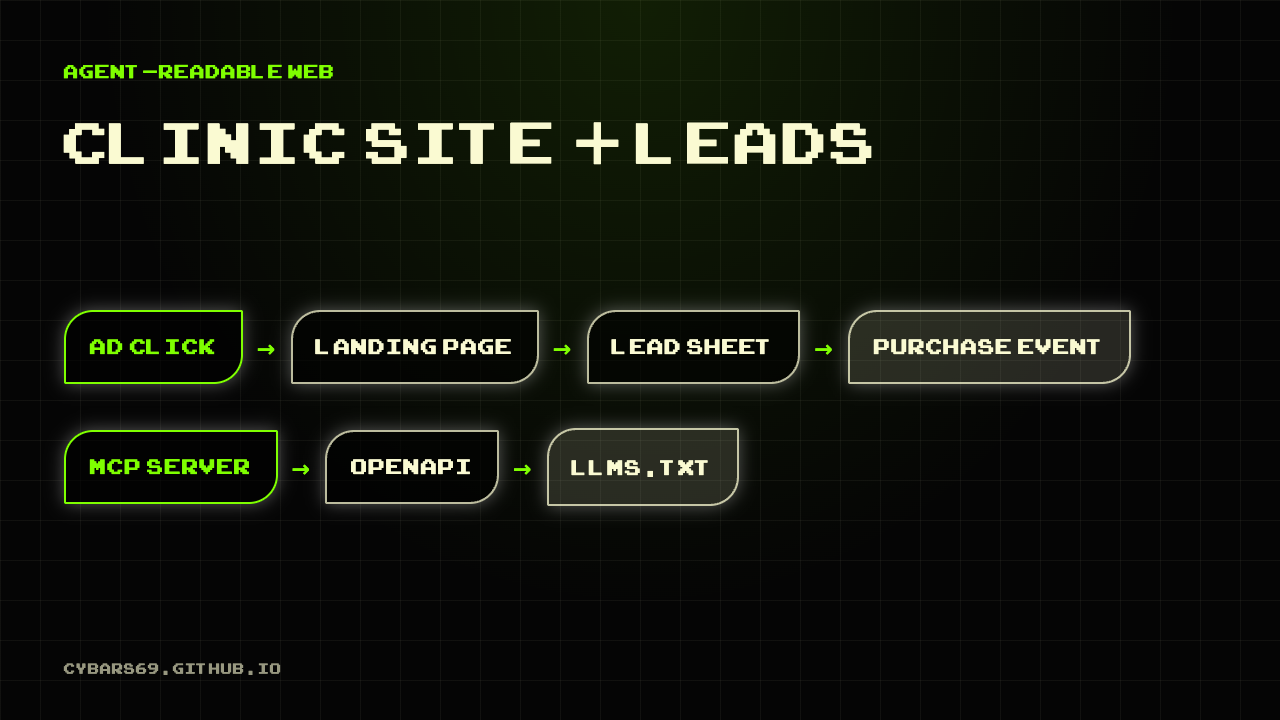
Clinic site and lead pipeline
A website for a clinic, built for two audiences: patients and the AI assistants patients increasingly ask first.
Readable by agents
The site publishes a small MCP server (stateless Streamable HTTP) with four tools: list treatments, get treatment detail, get clinic info, and request a consultation. Alongside it sit an OpenAPI 3.1 description, an MCP server card, an RFC 9727 API catalogue, an auth.md, an llms.txt, and a Markdown version of every page.
The rules for agents are written into the docs, and they matter more than the endpoints:
- There is no online calendar. A successful request means staff will phone the patient, and an agent must never report an appointment as confirmed.
- Get explicit consent before sending a name, phone number or medical concern.
- Never invent patient details, because a wrong number means staff cold-call a stranger.
- One submission per patient, since each one emails and phones real people.
From click to revenue
Every enquiry lands in a Google Sheet through a service account, with the attribution kept: UTM parameters, ad click identifiers, browser identifiers, landing page and referrer. Staff move each lead through a validated status list from lead to booked to active patient, and record amount paid and estimated lifetime value. When a lead converts, a server-side purchase event is sent back to the ad platform and the row is marked as sent, so the ad account learns which clicks became patients.
Stack
Google Sheets API, MCP, OpenAPI, structured data, server-side conversion events.