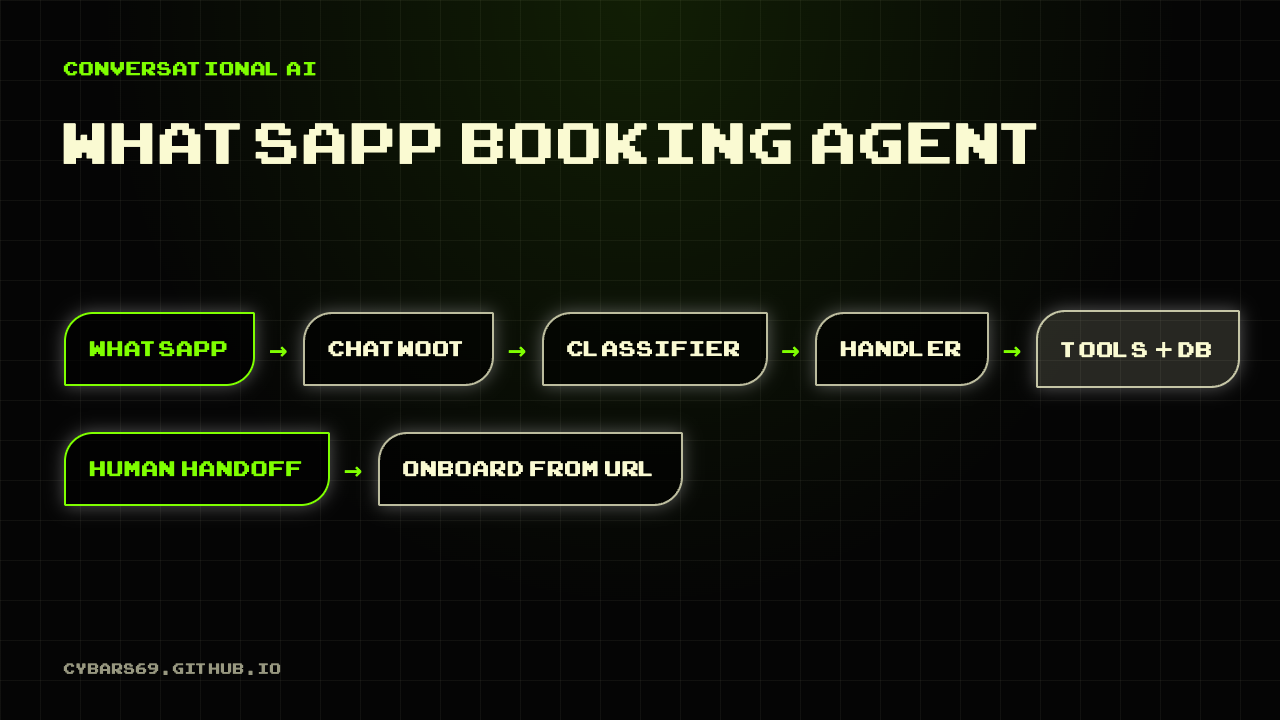
WhatsApp booking agent
A conversational agent for businesses that run children’s activity clubs. Parents message on WhatsApp; the agent answers questions and creates bookings, and hands over to a human when it should. Many businesses share one deployment, each with its own data, tone and rules.
The pipeline
WhatsApp → Twilio → Chatwoot (self-hosted) → agent-bot webhook
   → intent classifier (fast model)
   → router (plain Python)
   → handler (conversational model) + tools (database queries)
   → Chatwoot API → Twilio → WhatsApp
A small, cheap model classifies intent. A stronger conversational model handles the reply through a tool loop against the database. There are five handlers: greeting, query, booking, FAQ and escalation. Chatwoot gives every business a real inbox, conversation history and human takeover for free.
The rebuild
The first version ran on an agent framework. It was heavy, had no tests or evals, and had a scraping pipeline nobody wanted to own. The rebuild dropped the framework entirely, and I wrote it up in dropping the agent framework. It was planned in five phases: core agent, Chatwoot integration, onboarding, tests and evals, deployment.
Onboarding from a URL
A new business shouldn’t fill in forms. Three endpoints (website, document, raw text) fetch the content, extract products, locations, FAQs and tone with an LLM, and populate the tenant’s tables.
Composable configuration
Identity, personality, business rules and knowledge are separate concerns that can change independently. Changing a guardrail shouldn’t need a deploy, and businesses shouldn’t need to touch code to change how their agent sounds. The agent’s database and the operational booking backend are separate systems that deliberately do not sync.
Stack
FastAPI, SQLAlchemy, PostgreSQL, Gemini, Claude, Chatwoot, Twilio, Docker.